Written by
Kate Tobbe Ptak.
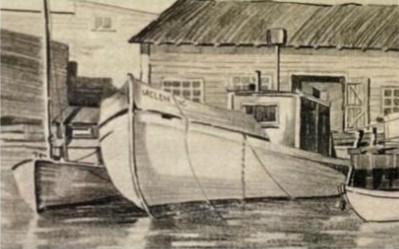
Picture: Fishtug The Helen K. at the Essexville Dock (Kavanaugh Family files)
My mother, Helen Kavanaugh Tobbe, aka Mudi, told the story that in 1886, when he was 16, Will began to work for
Sol Richardson, who owned a
local retail fish market. We were told that Will’s first job with Sol was
delivering smoked fish from a
cart, and that Sol became
his mentor and substitute father figure. Thus, W.P., as he was beginning to be known, worked his way up from delivery
boy into acquiring the business from Sol, who,
we were told, retired. This blog tells what we know about his business.
We do not have any company documents as they were either lost in the 1924 and/or the 1929 fire that destroyed the office
and the smoked fish department or were destroyed when the company was dissolved in the 1950’s. Our sources are primarily
news articles, an article in a book about prominent businessmen of Michigan, published in 1915, some private correspondence,
and family memories.
By the age
of 32, W.P. was reported as a prominent commercial fisherman in the Bay
City Tribune’s (now the
Bay City Times) Sunday Edition. By 1903, he owned property at the bottom of Fletcher
Street, in Thunder Bay River, Alpena. In April, he bought a second tug called Apache to join the Shasta,
giving the company two power boats in Alpena1.
According to the memoirs of Helen K. Tobbe, her father, W.P., had one of the largest fish companies in Michigan at the time. This is corroborated by
an article written by Charles Moore in 1915. Below is a quote from an article about W.P2.
“From a very humble start, he (W.P.) developed
a business in which a large force of men are now employed, and he has a trade which is the largest in live fish, and at the
same time employs much capital and many hands in the freezing, salting, and smoking of fish.”
A man
of his times, he took advantage of the new engine powered fish-tugs, trucks, and railroads that enabled him to ship his fish as far
as the Fulton Fish Market in New York City.
We
believe he was unique in operating five fish houses along the shores of Lake Huron, from Essexville to Alpena and operating
fish-tugs all along the lake. Our research has uncovered two other fish businesses that operated two or
three fish houses on Lake Huron and operating fish-tugs all along the lake3.
To accomplish this, W.P. had to own shoreline property along the
lake. According to family records, he began purchasing land in 1903, first in Alpena, then kept needing
to buy more land to comply with ever changing laws regarding fishing rights. Our records show him buying
land up to 1921. We have little information about who was passing these laws before 1929, when state and
national entities got organized. A Detroit Free Press article sheds some light on the source of these laws.4
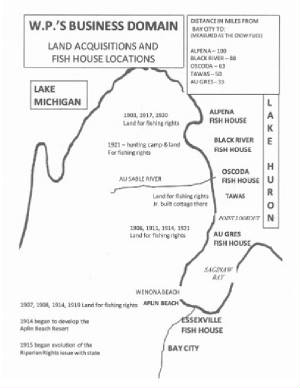
This map shows the land purchases as well as the locations of the
five fish houses in Essexville, Au Gres, Oscoda, Black River, and Alpena. The three major fish houses were
Essexville, Oscoda, and Alpena. We know that when W.P.’s sons were working with him, they each were in charge of one
of those three locations. The other two locations were for first step processing, then sending those fish
to the nearest of the three for the final processing and shipping of the fish to the various markets.
To make all this work smoothly, he needed a fleet of fish tugboats to get the fish to
and between the fish houses in time to send them off to the various fish markets in and out of state. We don’t
know how large his fleet of boats was at any one time. We have some information about the following ten boats:
Jennie Weaver, a schooner
Apache, a fish tug
Shasta, a fish tug
Sylvia, a fish tug
Helen K., a fish tug
Junior K., a fish
tug
Margaret K., a fish tug
John V. K., a fish tug
Duchess, a fish tug
Benbow, a fish tug
Mudi’s memoirs, Blog 5, posted in May, describes a typical
day in the fish business, so I won’t repeat that here, nor the stories of the Au Gres fishpond, the
rail tank cars to deliver living fish, and an attempt to develop a fish hatchery.
He opened Kavanaugh Fish Markets around the state; In 1915, he helped his
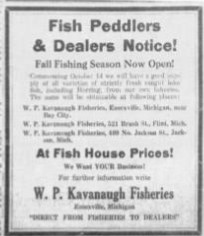
brother-in-law, Walter Donlon, start a fish market in Flint,
MI., Newspaper ads show that he also had a fish market in Jackson, MI. as well as the Essexville fish market
located at his fish house there; an ad in 1931 shows the addition of a fish market in Cassopolis.
Further blogs will talk about his other efforts to protect and
propagate fish to prevent a decline in fish available for commercial and sport fishing, and to explore other business opportunities
that may or may not be related to the fish business.
Image: Ad for Kavanaugh Fisheries open 1931 in Cassopolis (Newspapers.com, Cassopolis,
MI, Thursday October 8, 1931, 7)
The fish industry
on Lake Huron began to decline in the 1920’s for various reasons:
Ø over-fishing, both commercial and sport.
Ø water pollution from agricultural and industrial run-off and sewage,
that dropped deadly chemicals into the rivers and then into the bay and lake, destroying natural fish hatcheries and habitat
loss
Ø
invasive fish species such
as the Sea Lamprey, and
Ø restrictive
fishing laws that caused extra costs for fishermen 5
Many
commercial fish businesses failed, including W.P. Fisheries in the 1950’s. A future blog will discuss
the various ways W.P. worked to resolve these issues, but between his and his son John’s untimely deaths the remaining
brother, Junior, was unable to maintain the business and it was closed by 1953.
Sources:
1 Bay City Tribune, May 31, 1903 (Part 2) P8
2 History of Michigan, Vol. IV, author, Charles Moore, Lewes Publishing Co., Chicago, 1915
3 Bay
City Times-Tribune, Dec. 2, 1923, Sec. 2, pg. 12, col. 2
4 Detroit Free Press, March 15, 1923
5www.google.com/search?q=causes+of+fish+decline+in+bay+city+michigan+1920