Written by Kate Tobbe Ptak.
Based on all we have learned, it seems that W.P. was an entrepreneur, always looking
for ways to improve his business, the fishing industry, and serve his community. Here are some examples
of ways he took advantage of opportunities to achieve those goals. Many were successful, but not all he
turned his attention to worked out well.
Blog 5, posted in May, described
two of his efforts to deliver fresh fish to his buyers; the fish pond at Au Gres that failed because the rocks of the quarry
were limestone that leached minerals that killed the fish, and the rail car he designed that would be a fresh water tank so
the fish could arrive in the east still swimming. The design was successful, but too expensive at that time to be practical.
Below are other examples of his entrepreneurial inclinations.
In 1900, at the age of 30, W.P. and friends went to California and learned about property for sale in Shasta County, CA. He purchased two lots, thinking
of making money on the sale of olive oil from the trees that were to be planted and cultivated on those lots. The olive industry in that area flourished, but W.P. apparently never made money on that investment1. However, impressed with the
beauty of Mt. Shasta, he named one of his fishing tugs, Shasta.
In the winter
of 1904, there was a streetcar strike affecting transportation between Bay City and Essexville. W.P. arranged
to make one of his tug-boats available to run a ferry service between the two communities. It was the slow
season for fishing, which meant his boats were sitting idle, so he seized the opportunity to help people get back and forth
until the strike was resolved. It was probably not a free service2.
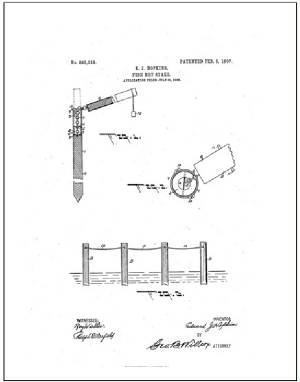
Another indicator of his eye for improving the fishing industry and his business is the fish net stake
patent that he co-owned with Eduard J. Hopkins that was patented in 1907. It was an improved stake to hold seine fish nets used in river or stream beds. Mr. Hopkins was the inventor of this fish net stake with W.P. offering financial support. The device involves a top piece on the
stake that can be flipped up in season to hold the nets, then flipped down below the water line to protect the stake in the
winter and early spring from the ice floes coming down the river that tore up the existing stakes3.
In the 1890’s and early 1900’s, Bay City's wealthy enjoyed their summertime waterfront cottages
near the Wenona Beach Amusement Park which was first opened in 1887. This park was located at the end of the trolley line that ran from Bay City to the Saginaw Bay waterfront where the Saginaw River emptied into the bay. W.P. leased land from the Aplin Estate next to
Wenona Beach in 1908 to establish fishing rights in Saginaw. As a savvy businessman, he saw an opportunity to branch out into
real estate development. So, in 1912, when he was 42 years old, W.P. bought the land in Bay County
from the Aplin Estate1.
By 1914 he was selling lots for the Aplin
Beach Sub Home Sites on that
land. Brochures and promotional materials indicate that he was developing a summer get-away community for people
of nearby cities1. That development is still there today, at the end of Patterson Road.
A legal battle lasting 15 years regarding Riparian Rights evolved
from this project that will be covered in our presentation October 10th, 2025 at the Bay County Historical Society
Museum.
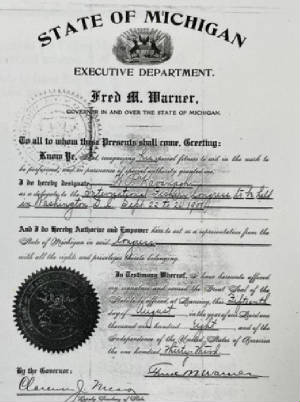
By 1908, at the age of 38, W.P. was
the president of the Michigan Commercial Fishermen’s Association, and was
a delegate representing the state of Michigan to the International Fishery Congress held in Washington, D.C. This was the first time Michigan was represented in the national association. In that same year he
was named Director of the Exec. Committee of
the US Federal Fisheries Association Atlantic City, NJ. These associations were started by the commercial fishermen who were trying to protect the fish and find better ways to keep their
fish populations thriving1.
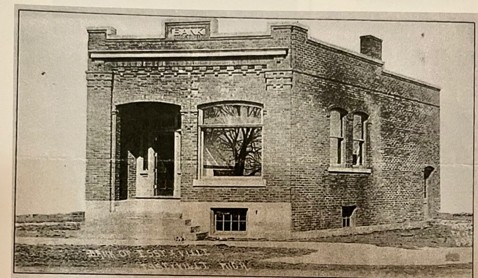
In 1911, the State Savings Bank of Essexville was incorporated and W.P., age 41, was named its president. He along with other Michigan businessmen, were the founding members of this bank. Leo J. Navarre was the first manager of the new bank.
In the 1922 Bay City Directory, W.P. is again listed as President of the State Savings Bank of Essexville, MI1.
In August of 1920, The Sun Coal
Mining Co. in Bay County, MI was sold to W.P.
with collateral of $7,000.001.
In 1921, he
bought property in Fairfield, Oscoda Co. that included Lake Shear.
When he realized that Lake Shear was not a
good site for a fish hatchery because the lake
bottom was too silty for the fish eggs he wanted to seed and spawn,
he kept the property to serve as a get-away fishing/hunting camp for himself and the family. His sons enjoyed
that property more than he did. Later, in 1951, his son, W.P. Junior, sold this property to a minister who developed it into
an overnight camp for poor children, especially
for city kids who never experienced the joy of
living in the wild1.
Below is a brief story relating to the sale of
the property as told to me by the minister’s son in the summer of 2024 when my brother, Bill, my cousin, Jack, and I
visited the camp.
In Sept. 1951 the minister, Mr. Johnson, went to look at Shear
Lake and found the site of his dreams. He contacted Junior, W. P’s surviving
son, who had been offered $30,000 to $44,000 by sportsman clubs. Junior offered a
price of $20,000 after hearing what the minister proposed to do. The minister had
a short time frame for raising that amount. He succeeded. The purchase covered
the acreage, the lake, and an old tar-papered shack. The minister’s son was most intrigued by the purpose of that
old shack.
Camp Barakel is still
fulfilling that minister’s mission. For information about Camp Barakel as it exists today you can go to www.campbarakel.org
Sources:
1 Kavanaugh Family Files
2 Told to Les Arndt, Bay City Times, June
14, 1980, article, by Robert Trudell, 715W. River Road, Oscoda, Michigan
3 Patent # 843,339.
Issued Feb. 5, 1907