Written by Kate Tobbe Ptak.
TIMES IN GENERAL
Now that I have introduced W.P. Kavanaugh to
you, I am going to review the exciting times that W.P. lived in. Hopefully this will refresh your memories
of the advance of technology and it’s impact on daily life.
The Industrial Revolution, begun in the 1750’s, made it possible to use mechanical equipment to
make life easier. Rather than relying on exclusively human made, animal powered, or wind and water powered means, by using
machines, people and goods were able to get around more quickly and easily, more things were produced, transported, sold,
and used. In 1769 Watt’s separate condenser model introduced the way for the steam engine to be invented. After
that breakthrough, other major changes include:
1804: The first steam locomotive
1831: Electricity
harnessed as a useful power source1835: Natural gas first
used industrially - the beginning of oil drilling and
production
1859:
First successful gas engine
1878: Gas engine became a commercial success
1879: The light bulb
1885: Engines for the “horseless carriage” – the prototype of the modern automobile
1895:
Radiotelegraphy – wireless communication for long distance person to person messaging
Due to these and many other developments, all major industries were affected: agriculture, automobiles,
chemicals, communications, commercial fishing, metals, military, printing, textiles, and transportation1.
BAY CITY – BEGINNINGS TO THE DAYS OF
W.P.
Let’s recall that lumber was king at the time of the founding of Bay City in 1865. Lake Huron and the
Saginaw River proved an excellent highway for the lumber that was cut in the north woods. Soldiers came home after
the Civil War looking for work and became lumbermen.
They spent November through March up in the lumber camps where alcohol and women were
not allowed. So, with the spring thaw about 5,000 lumbermen who had been
working non-stop in brutal conditions, came to Bay City to spend their $150 paychecks2.
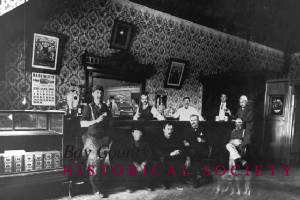
Image: Local Bay City Bar during the lumbering era. (Source: Bay County Historical Society)
Hell’s Half Mile on Water Street, along Bay City’s waterfront, was where these lumbermen would come to spend their paychecks
on alcohol, hotels, entertainment, women, and shows. When their money ran out,
they would then farm, work in the sawmills, or find any other work they could. The
cycle would repeat year after year2.
A major development that sparked a sharp
increase in industry and population
was the arrival in 1867
of the first
railroad that connected Bay City to Saginaw and from there to the rest of southern Michigan and the country. In 1886, a common
carrier railroad line extended to the north from Bay City to Alpena. Bay City was a community growing in population
and industrial diversity, guaranteeing survival for
the future.
The growth and diversity of business and industry was reflected in
the population figures from the U.S. Census. In 1870, the citizenry of Bay
City totaled 7,064 and 10 years later, the figure nearly tripled to 20,693. By 1890,
the population had grown to 27,839. Every business needed cheap labor, and a large
influx of immigrants arrived to fill the need. They brought with them their language, their customs, and their faiths, which meant new churches
sprang up in just about every neighborhood. Along with those churches, many denominations
had their own parochial schools, but it was St. James Catholic School, from grade one through twelve, built in 1873, that
contained the first parochial co-educational high school in America.2 St. James was the Irish parish
in Bay City
and the school was attended by W.P.'s children and the Kavanaugh grandchildren.
Bay City was thriving, originally fueled by the logging industry.
The use of Lake Huron and its rivers
by the logging industry to move logs from the lumber camps to Bay City had damaged a thriving fishing industry. This practice
seriously impacted the natural fish hatcheries and habitats along the shoreline, the rivers and river mouths. In the 1890s, the logging industry
began to fade, and the fish population began to recover3.
More industries evolved, including coal mining, railroads, commercial shipping and commercial
fishing, which became a leading industry along Lake Huron and Saginaw Bay, which were teaming with fish. Bay City/Essexville
became a center for processing fish to be delivered locally and beyond.
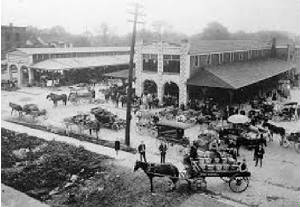
Image: Busy Day in Bay City (Source Bay County Historical Society)
Other industries included flooring manufacturers, carriage makers, many of those evolving into manufacturing cars and
trucks, and livery shops that evolved into gas stations and auto repair businesses. As the population grew, there was an additional
need for clothiers and tailors, household items,
furniture
and dozens of other manufactured goods, and retail stores2.
As a young boy, W.P. witnessed all the excitement
of new inventions that changed how Bay City grew as a boom town. He may have even arrived by train.
In 1884, at the age of 14,
W.P. left the family home and went to
work as a laborer. I think that as
an enterprising young man
he saw opportunities to take advantage of all the options for building a business career in a thriving Bay City.
I also think he may have worked for the next two years in many businesses, possibly finding seasonal jobs, learning
about many industries and commercial businesses. He may have even spent a season or two on a fish boat,
learning the everyday practical aspects of that business first- hand.
In 1816, when he
started to work for Sol Richardson, he may not have known that this was going to be the industry that he would be involved
in for the rest of his life. This job introduced him to the commercial business side of the fish industry.
That coupled with some possible experience on a fish-boat, would set him up for his quick building of a multi-faceted
business stretching all along the western Lake Huron shores, processing and shipping fish locally and as far as New York City’s
Fulton Fish Market.
Sources:
1 https://www.britannica.com/technology/history-of-technology/The-20th-and-21st-centuries
2 https://www.mlive.com/news/bay-city/2015/07/bay_city_at_150_lumber/ruled_a.html
3 https://www.hrwc.org/wp-content/uploads/2014/02/Michigan-Fisheries_-200-years.pdf